
I had this interesting treat at the very top of my TBR list – Marjane Satrapi’s Persepolis. The graphic novel tells the story of Marjane, born in Iran who lived in Tehran until she turned 14 – all during the islamic revolution, the fall of the Shah and the trauma of the Iran-Iraq war.
The graphic novel, or comic book proved to be a fine medium to tell deep, serious topics, traumas (even Satrapi realizes this while reading Art Spiegelman’s The Complete Maus that was made based on the memoirs of a survivor of the Holocaust) – Satrapi as a graphic designer and writer finds this as her perfect way of story telling instead of a genre and it turns out a great piece of art.
The storyline starts when Marjane is a little girl coming of age in the 1970 and 1980, in an upper-middle class family that is not particularly religious. At the age of 14 her parents send her away to study abroad in Wien, Austria, where the teenager experiences a whole new world, all alone, being too Eastern for the West, no relatives or friends living a much more free life in many senses. At the lowest of her years in Austria (living in the streets), she eventually decides to return home, in the hope to find herself again – but find herself lost back in Tehran, too. Depression and search for meaning and purpose leads her to college where she gets admitted and starts training for a graphic designer. She meets a war veteran and despite all her effort to revolt and stand against the strictness of the regime, she ends up getting married with Reza – mainly so that their lives can become easier: they move in together and find out that they don’t fit together.
Satrapi graduates college and eventually moves to France to continue her studies, but more importantly moves out of Iran, on family decision, to live a free and modern life in the West.
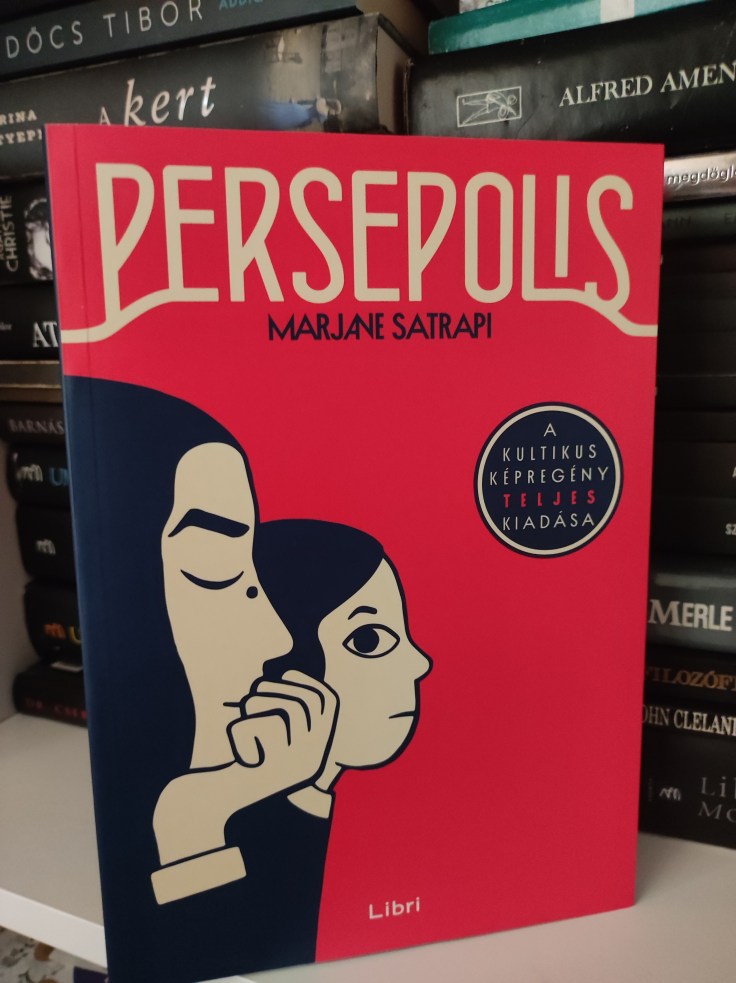
I really appreciated the smart sense of humor that appears and complements the simple, yet powerful images that broadcast strong emotions. The genre makes it powerful, makes it easy to read, yet gives a lot to think about as it presents so many layers of cultural, political and psychological aspects while telling a personal story from the perspective of a little girl, so the tone is simple, relatively objective, including elements of reflection on episodes when the girl didn’t act right. It documents the story, but also gives a platform to work through and process traumas.
Originally published in French in 4 parts between 2000 and 2003, then in English in 2 parts in 2003-2004. The complete version with the whole story in one volume was first published in 2007. Criticism about the book and such memoirs in general include the fact that it helps preserve the anti-Iran sentiment across the Western world, a reinforcement of preconceptions and prejudices about it, and, whether intentionally or unintentionally, it is a political statement, usually in a personal, not necessarily objective context. But when one thinks about it: Satrapi isn’t a historian – she’s a witness. Remembering your own past is rarely a sterile document, but a writer’s text with one’s own partial truth and statement and in there lies the biggest strength of it.
Reading this was a nice journey and would definitely recommend to everyone, not just young adults (who were originally meant as recipients of this comic book) – read it with an open mind, with sensibility and curiosity. And enjoy the drawings!
 Még pár oldal - a betűgyár